How to Read Tire Sizing: The Complete Guide for Trucks & 4x4s
May 30, 2026
Looking at the sidewall of a tire can feel like trying to decode a secret language. With all the letters, numbers, and slashes, it's easy to get overwhelmed – especially when you're investing in a premium setup for your truck, Jeep, or SUV.
At Level 4x4, we believe customizing your rig should be exciting – not stressful. Whether you're replacing worn OEM tires or sizing up for an aggressive off-road stance, understanding your tire size is the first step to getting the perfect fit.
Here's a complete, no-fluff guide to reading tire sizes, tailored specifically for truck and 4x4 owners.
Where to Find Your Current Tire Size
Before you can shop, you need to know what you're running now. Check any of these three sources:
Driver's door jamb sticker – The manufacturer's recommended size for your exact trim, printed right where the door meets the frame.
Owner's manual – Lists factory size and load specs.
Sidewall of your current tire – Shows the actual size installed (which may differ from factory if a previous owner sized up).
If the door jamb size and your current sidewall don't match, you already have an aftermarket setup – worth noting before you order replacements.
The Two Main Tire Sizing Formats
In the truck and 4x4 world, you'll run into two formats: Metric (LT/P) and Flotation (High Flotation). Both describe the same thing – just in different units.
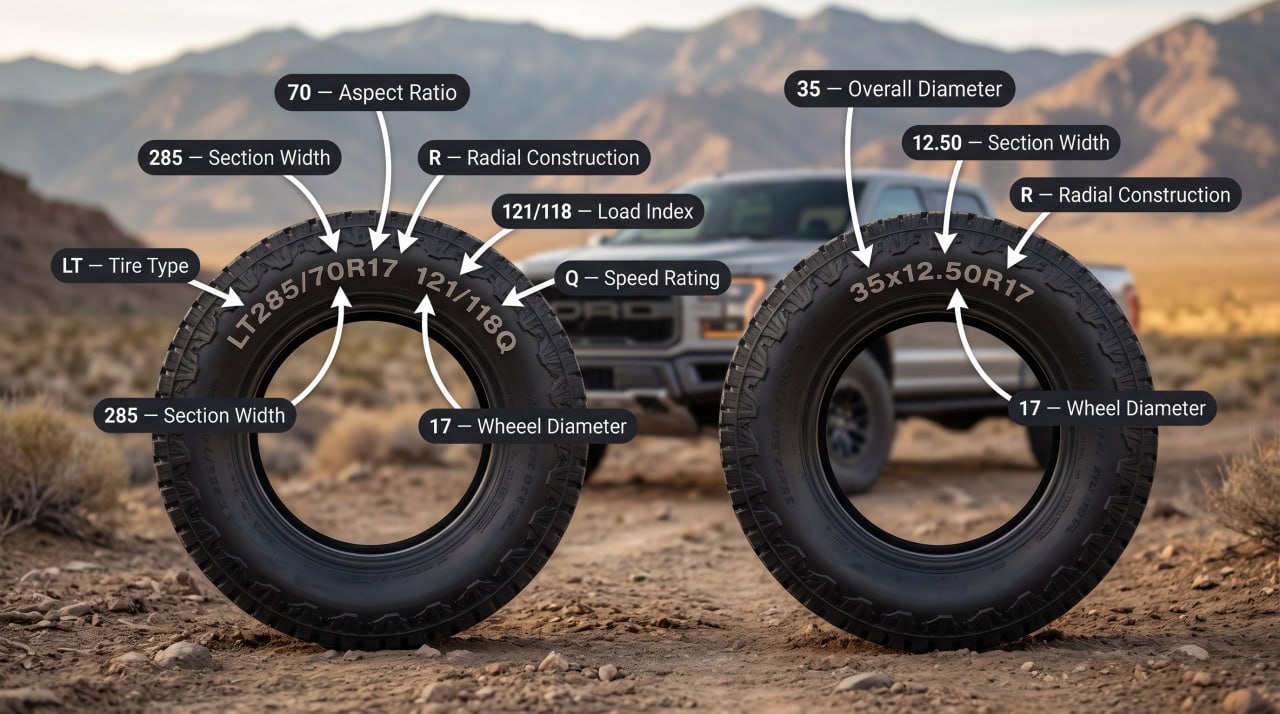
Metric Tire Size (Example: LT285/70R17 121/118Q)
This is the most common format on factory trucks and many aftermarket tires. Here's what each part means:
LT (Tire Type) – Light Truck. Built with reinforced sidewalls and higher load capacity – essential if you tow, haul, or take your truck off-road. Other letters you might see:
P – Passenger (lighter SUVs and daily highway driving).
ST – Special Trailer (trailer use only – never a tow vehicle).
No letter – Euro-metric, sized similarly to P-metric but with different load standards.
285 (Section Width) – Width from sidewall to sidewall, measured in millimeters.
70 (Aspect Ratio) – Sidewall height as a percentage of the section width. Here, sidewall height = 70% of 285mm ≈ 200mm. A higher number means a taller, meatier sidewall – better for airing down on trails.
R (Construction) – Radial, the standard for modern tires. You may rarely see "D" for bias-ply (off-road specialty) or "B" for belted bias.
17 (Wheel Diameter) – Wheel size the tire is designed to fit, in inches. This number must match your wheel exactly.
The Bonus Numbers: Load Index & Speed Rating (121/118Q)
121/118 (Load Index) – Maximum weight the tire can safely support. For LT tires you'll often see two numbers: the first (121 = 3,297 lbs) is the capacity when used as a single wheel, the second (118 = 2,910 lbs) is per tire when running duals on the rear axle. Never downgrade the load rating from factory if you tow or haul.
Q (Speed Rating) – Maximum safe sustained speed. Off-road and mud-terrain tires usually carry lower ratings (Q = 99 mph, R = 106 mph) because they're engineered for traction and durability, not track speeds.
Flotation Tire Size (Example: 35x12.50R17)
If you're lifting your truck or going for an aggressive aftermarket look, you'll see Flotation sizes a lot. Everything is in inches, so they're easier to read at a glance.
35 (Overall Diameter) – Total tire height: 35 inches.
12.50 (Section Width) – Tire width: 12.5 inches.
R (Construction) – Radial.
17 (Wheel Diameter) – Fits a 17-inch wheel.
Metric ↔ Flotation: Quick Conversion
Flotation Size | Closest Metric Equivalent | Actual Diameter |
|---|---|---|
33x12.50R17 | LT285/70R17 | ≈ 32.7" |
35x12.50R17 | LT315/75R17 | ≈ 35.6" |
37x12.50R17 | LT315/70R18 (or 37" flotation) | ≈ 34.3" (metric) / 37" (flotation) |
A common misconception: an "LT285/70R17" is often marketed as a 33-inch tire, but the actual diameter is closer to 32.7". Diameter listed on the box ≠ true measured diameter – always check the spec.
Other Important Sidewall Markings
The size string isn't the only thing stamped on your tire. Here's what else to look for:
Load Range (LR C, D, E, F) – Indicates ply rating and pressure capacity. Most aggressive LT tires are Load Range E (10-ply equivalent). Heavy-duty hauling may require Load Range F.
M+S – Mud and Snow rated for basic all-season traction. Most A/T and M/T tires carry this mark.
3PMSF (Three-Peak Mountain Snowflake) – Certified for severe snow conditions. If you drive in winter regions, look for this symbol – M+S alone isn't enough for true snow performance.
DOT Code – A 4-digit number at the end of the DOT serial showing week and year of manufacture (e.g., "3823" = the 38th week of 2023). Tires older than 6 years should be inspected, regardless of tread depth – rubber hardens with age and loses wet grip.
Max Load & Max Pressure – Printed near the bead. Never exceed the max cold pressure listed on the tire.
When to Size Up
Upgrading tire size is the fastest way to gain ground clearance and give your truck an aggressive stance. But jumping from a 31-inch OEM tire to a 35-inch mud-terrain isn't bolt-on – it usually requires:
A leveling or lift kit to clear the new tire on full lock and full compression.
Custom wheels with the correct offset to push the tire away from suspension components and avoid rubbing.
Possible upper control arm upgrades, fender trimming, and re-gearing depending on tire size.
For exact lift heights and offset recommendations per tire size, see our Lift Guide for 33", 35" & 37" Tires.
Still Unsure? Let the Experts Handle Fitment
You don't have to be a tire engineer to get the perfect setup. At Level 4x4, we take the guesswork out of the equation.
Simply enter your Year, Make, Model, and Trim into our search tool. Once you place an order, our dedicated fitment specialists review every single wheel and tire package to confirm bolt pattern, offset, load rating, and clearance – before anything ships. If you're running a lift, leveling kit, or spacers, drop those details at checkout and we'll verify the stance.
FAQ: Tire Sizing
How do I know if a tire will fit my exact vehicle?
Use our Shop by Vehicle filter with your Year, Make, Model, and Trim. The system pulls only compatible sizes. If you've already modified your suspension, contact us before ordering – we'll verify clearance manually.
Can I mix metric and flotation sizes on the same vehicle?
No. All four tires should match in format, diameter, width, and load rating. Mixing sizes affects handling, ABS calibration, and differential wear.
Why does my new tire diameter not match the number on the box?
Marketed size (e.g., "33-inch") is often rounded. Actual measured diameter depends on width, aspect ratio, and load. Always check the spec sheet, not the marketing label.
What load index do I need for towing?
Match or exceed the factory load index listed on your door jamb sticker. Going lower compromises towing safety – going higher is fine.
How old is too old for a tire, even if the tread looks good?
Six years is the inspection threshold. Ten years is the hard replacement limit, regardless of tread depth – rubber compounds harden and lose wet-weather grip with age.
Other articles
Shop Wheels with Confidence: The Ultimate Wheel Specs Guide
Swapping the wheels on your truck or SUV changes everything – from its aggressive look and off-road capability to how it handles on the highway. But buying aftermarket wheels isn't a guessing game. Being off by just a few millimeters can lead to dangerous steering vibrations, rubbing against suspension parts, or hardware failure. Plus, the stakes are high – once a tire is mounted to an aftermarket wheel, the item is considered used and is no longer eligible for standard returns.
At Level 4x4, our goal is zero surprises. We put together this guide on wheel size, bolt pattern, offset, and hub bore so you can shop with confidence and get your dream stance right the first time.
Finding Your Specifications
Before ordering, it's crucial to know what your truck currently runs and what clearances you have. You can typically find your factory specifications:
Stamped on the back of the wheel hub or inner spokes
On the driver's side door jamb sticker
Within your vehicle owner's manual
A full aftermarket specification string usually looks something like this: 17x9J ET-12 6x139.7 CB106.1.
Here's what those numbers actually mean.
Wheel Size: Diameter and Width
The first numbers in the sequence (e.g., 17x9) determine the physical footprint of the wheel.
Diameter (17"): This is the total distance across the center of the wheel, measured from the inner bead seat to the opposite bead seat – not across the outer physical lip. Off-road enthusiasts often prefer smaller diameters (like 17-inch wheels) to allow for massive, meaty tire sidewalls that absorb trail impacts. Meanwhile, street-focused show builds may lean toward 20-inch, 22-inch, or 24-inch wheels.
Width (9"): Also measured internally between the bead seats, wheel width determines the permissible range of tire sizes you can safely mount. Mounting a tire that is too wide or too narrow for the rim can lead to uneven tread wear, crowning, and unstable cornering.The Tire and Rim Association publishes the approved tire-to-rim width pairings that manufacturers follow when engineering their fitments.
The "J": You may occasionally see a letter following the width (e.g., 9J). This simply indicates the flange contour type – the universal standard for modern passenger vehicles and light trucks.
Bolt Pattern (Pitch Circle Diameter)
Your bolt pattern (e.g., 6x139.7 or 6x5.5) dictates whether the wheel will physically bolt onto your vehicle's axle hub. This measurement requires a dead-on match – a 5x114.3mm pattern will not safely fit a 5x115mm hub. Top brands like Method Race Wheels and Fuel Off-Road engineer wheels specific to these tight tolerances.
Lug Count: The first number (6) represents the number of lug holes. Heavy-duty trucks and off-roaders usually need 6 or 8 lugs to handle massive torque payloads, while smaller SUVs may use 4 or 5 lugs.
Diameter: The second number (139.7mm or 5.5 inches) is the diameter of an imaginary circle intersecting the exact center of each lug hole.
How to Measure at Home: If you have an even number of lugs (4, 6, or 8), simply measure from the center of one hole directly across the hub to the center of the opposite hole. For 5-lug wheels, the geometry is trickier – you must measure from the extreme outer edge of one lug hole to the exact center of the hole furthest away.
Offset and backspacing describe the exact same physical positioning of the wheel, but they use different reference points. Getting these specs right determines whether your wheels will tuck inside the fenders, sit flush, or poke out aggressively. For a deepe dive, see our complete guide on wheel offset.
Wheel Offset (ET) – Measured in millimeters, offset is the lateral distance from the wheel's geometric centerline to the hub mounting pad.
Positive Offset (+): The mounting pad is closer to the street side, pulling the wheel deep into the fender. This is the conservative standard for modern factory trucks.
Zero Offset (0): The mounting pad is dead center, offering a balanced, flush look on leveled trucks.
Negative Offset (-): The mounting pad is closer to the brake side, pushing the wheel barrel outward to create a deep-dish aesthetic and an aggressive "poke."
Wheel Offset Comparison Table
Type Offset | Positive (+) | Zero (0) | Negative (-) |
|---|---|---|---|
Hub Position | Mounting pad closer to the wheel face | Mounting pad centered | Mounting pad closer to the back of the wheel |
Looks | Tucked in (closer to fender) | Flush with fender | Deep Dish / Sticks out |
Common Use | FWD cars, modern SUVs, many OEM setups | Older 4x4s, trucks, classic off-road setups | Off-road, lifted trucks, RWD builds, stance setups |
Backspacing – Preferred by the off-road suspension industry, backspacing measures the total physical distance from the extreme inner lip of the wheel to the mounting pad in inches. It directly dictates your internal clearance for upgraded steering knuckles, struts, and upper control arms.
Pushing wheels far out with extreme negative offsets alters your scrub radius and increases the leverage applied to your suspension, which can accelerate wear on your wheel bearings.
Hub Bore and Centricity
The hub bore (or center bore) is the large machined hole directly in the center of the wheel's backpad.
OEM wheels are hub-centric – the center bore matches the truck's axle hub perfectly, and the heavy steel hub carries the vehicle's immense vertical weight.
Aftermarket wheels (like many from Fuel Off-Road or KMC Wheels) are frequently built with intentionally oversized center bores so a single wheel design can fit multiple vehicle platforms, making them lug-centric.
If you install lug-centric wheels without correction, the relatively thin lug studs are forced to bear the truck's entire weight – which routinely leads to severe steering wheel vibrations at highway speeds.
The fix is simple but required: always install hub-centric rings. These precise plastic or aluminum shims bridge the void between the oversized wheel bore and your specific vehicle hub, converting a lug-centric fitment into a safe, vibration-free hub-centric fitment.
Frequently Asked Questions
Can I reuse my factory lug nuts with aftermarket wheels?
Almost never. Aftermarket wheels generally require specific lug nut seat types – typically a 60-degree conical or tapered seat – that differ from factory ball or mag seats. Reusing OEM lug nuts damages the wheel seat and can cause the hardware to loosen while driving. We offer compatible lug nut kits, including locking options, directly at checkout.
Do I need a lift kit for negative offset wheels?
Aggressive negative offsets widen your track width and increase your turning arc. Pushing the wheels outward often causes the tires to crash into the front bumper valance or inner fender liners during turns. A leveling kit, lift kit, or minor plastic trimming is usually required to safely run negative offsets. For specific tire size requirements, see our suspension lift guide.
What happens if I get my specs wrong?
Getting specs wrong leads to mechanical interference, dangerous high-speed vibrations, and wasted money – mounted wheels cannot be returned. That's exactly why our fitment specialists verify every order before it ships.
How do I find my bolt pattern if I don't have the owner's manual?
Check the markings on your current wheels or the driver's side door jamb sticker. Most vehicles also have well-documented bolt patterns by year and model. If you're not sure, select your vehicle on our site or message us – it takes about 30 seconds and prevents ordering the wrong fit.
Is backspacing or offset more important?
Neither replaces the other – you need to know both. Offset is the industry-standard spec sheet measurement, while backspacing directly tells you how much internal clearance you have for suspension and steering components. Together, they give you the full picture of where your wheel sits.
Buy with Confidence at Level 4x4
Nailing that custom look means getting your size, bolt pattern, offset, and hub bore exactly right. Don't leave your fitment to chance.
At Level 4x4, our dedicated fitment specialists verify every single order for exact compatibility – zero surprises. Simply enter your vehicle's Year, Make, Model, and Trim into our system and explore top-tier wheel and tire packages from brands like Fuel Off-Road, Method Race Wheels, and KMC Wheels. All of our complete packages arrive professionally mounted, precision balanced, and ready to bolt directly onto your truck.
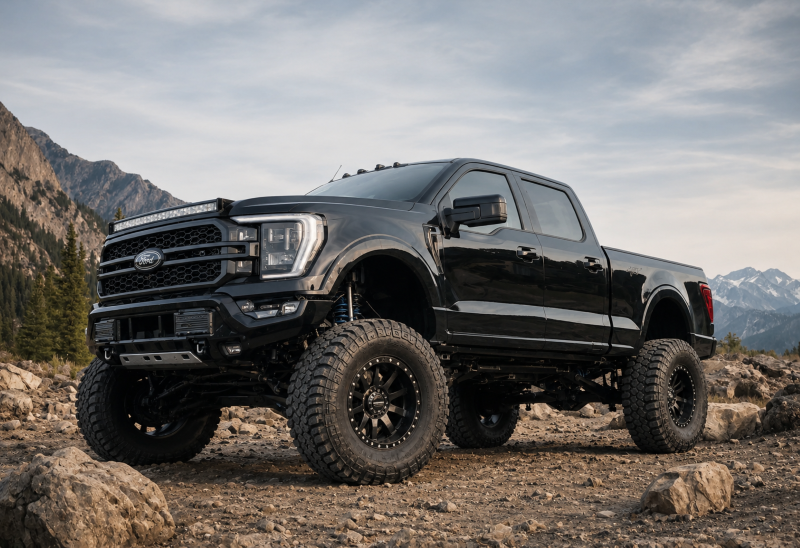
Do I Need a Lift Kit for 33", 35", or 37" Tires? Real Setup Guide
Do I Need a Lift Kit for 33", 35", or 37" Tires? Real Setup Guide
Upgrading to 33", 35", or 37" tires is the ultimate way to give your truck a bolder, customized stance that stands out. However, bolting on larger rubber changes much more than just ground clearance — it fundamentally alters your vehicle's suspension geometry, gearing, and braking performance.
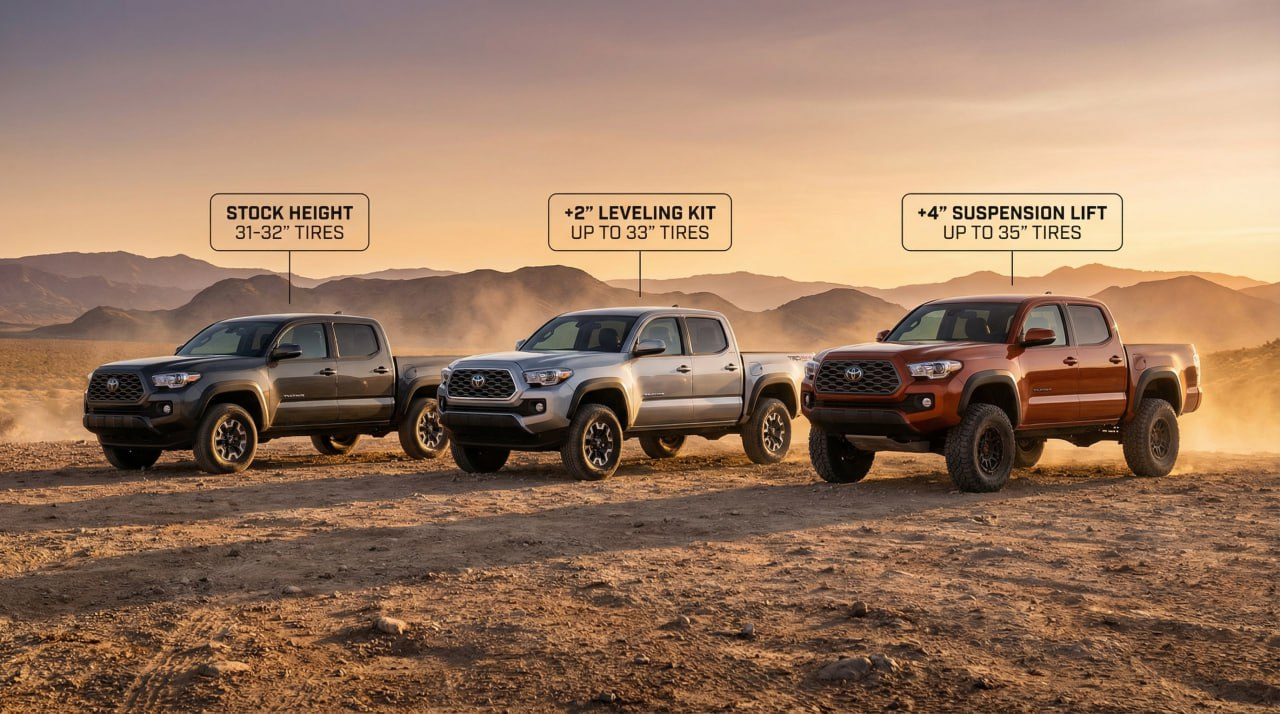
A lift kit provides the vertical clearance needed for larger tires, but achieving a rub-free setup requires a precise calculation of wheel offset, tire width, and suspension travel. Generally, 33" tires require a 0 – 2" leveling kit, 35" tires demand a 2 – 4" suspension lift, and 37" tires necessitate a comprehensive 4 – 6" lift with drivetrain modifications.
 https://level4x4.com/storage/IrNjZTCXulVJLllvM4vqDmxxaKDxRr0FOjth9J2M.png
The Core Requirements: How Tire Size Dictates Lift Height?
Tire size directly dictates how much lift you need. A leveling kit (1 – 2") clears 33" tires, a 2 – 4" suspension lift handles 35", and 37" tires require a full 4 – 6" lift to prevent fender rubbing and maintain safe suspension travel.
33" Tires: The Accessible Upgrade
Fitting 33-inch tires is the most straightforward upgrade. Most modern half-ton trucks can accommodate this size with minimal modification.
Lift Required: 0 to 2 inches (Leveling Kit).
Supporting Mods: Minor plastic trimming inside the wheel well.
Wheel Offset: Positive to zero offset (e.g., +18 to 0).
35" Tires: The Turning Point
Moving to 35-inch tires requires physically altering the vehicle's resting height to ensure the tires do not crash into the body during turns.
Lift Required: 2 to 4 inches (Suspension Lift).
Supporting Mods: Upgraded Upper Control Arms (UCAs), bump stop drops, and potential crash bar modifications.
Wheel Offset: Zero to mild negative offset (e.g., 0 to -12).
37" Tires: The No-Compromise Build
Mounting 37-inch tires is a major engineering shift. It's not just about fitting the tire in the wheel well — it's about ensuring the vehicle can handle the massive increase in size.
Lift Required: 4 to 6 inches (Full Suspension Lift).
Supporting Mods: Re-gearing, heavy-duty steering components, and brake upgrades.
Wheel Offset: Negative offset (e.g., -12 to -24).
Table 1: Lift & Modification Cheat Sheet
Target Tire Size | 33" | 35" | 37" |
|---|---|---|---|
Typical Lift Required | 0–2" (Leveling Kit) | 2–4" (Suspension Lift) | 4–6" (Full Lift Kit) |
Wheel Offset Recommendation | +18 to 0 | 0 to −12 | −12 to −24 |
Supporting Mods Usually Needed | Minor plastic trimming | UCAs, minor trimming, bump stops | Re-gearing, calibration, brake upgrades |
FAQ: Tire Size and Lifts
Can I fit 35" tires on a stock truck?
Rarely. Without a 2 – 4" lift, 35" tires will severely rub against your crash bars and fenders, especially when turning or hitting bumps.
Will a leveling kit fit 33" tires?
Yes, a 1.5 – 2" leveling kit is usually perfect for clearing 33" tires while removing the factory nose-down rake.
The Clearance Equation: Why Lift Height Isn't Enough?
Lift height only moves the truck body up; it doesn't affect how much clearance the tire has during suspension travel and full-lock turns. Wheel offset, backspacing, and tire width dictate whether your tire will rub against the frame or suspension components.
Understanding Suspension Geometry
When you lift a truck, you change the operational angles of the factory suspension. According to Dixon (2009) in Suspension Geometry and Computation, altering the ride height without correcting the control arm angles leads to poor camber curves and bump steer. This is why aftermarket Upper Control Arms (UCAs) are mandatory for lifts over 2 inches.
The Role of Wheel Offset
Offset determines how far "in" or "out" a wheel sits. A shift of just 5mm can cause a tire to hit the upper control arm (if too positive) or the outer fender (if too negative).
The Bearing Load Factor
Pushing wheels further out with negative offset increases the mechanical lever arm on your wheel hub. A 2022 study in SAE Technical Papers (Lee et al.) highlights that aggressive negative offset, combined with the heavy unsprung mass of larger tires, exponentially increases the fatigue load on automotive wheel bearings.
FAQ: Clearance and Offset
What is the best offset for 35" tires?
A zero to mild negative offset (0 to -12) is generally best to keep the tire off the control arms while minimizing fender rubbing.
Why do I need new Upper Control Arms (UCAs)?
Factory UCAs max out their ball joint angles when lifted. Aftermarket UCAs restore proper geometry and allow for full suspension travel.
The Hidden Impact: Drivetrain, Gearing, and Braking
Larger tires increase unsprung weight and change the effective gear ratio, which reduces acceleration, throws off your speedometer, and drastically increases braking distance.
Gearing and Tractive Effort
Upgrading to larger tires creates a numerically lower effective gear ratio. Wong (2008) in Theory of Ground Vehicles explains that increasing tire diameter directly decreases the tractive effort delivered to the road. This makes the truck feel sluggish. For example, moving from 31" to 37" tires decreases effective torque by nearly 19%.
"Bolt on 37" tires without re-gearing, and you haven't upgraded your truck — you've handicapped it." — Level 4x4 Fitment Specialists
Table 2: Gear Ratio Correction Guide (Baseline: 33" Tires)
Stock Gear Ratio (on 33") | Equivalent Ratio for 35" Tires | Equivalent Ratio for 37" Tires |
|---|---|---|
3.31 | ~3.51 | ~3.71 |
3.55 | ~3.77 | ~3.98 |
3.73 | ~3.96 | ~4.18 |
Speedometer and Braking Physics
Because a larger tire covers more ground per revolution, your speedometer will read slower than your actual speed. Furthermore, heavier tires increase rotational inertia. A comprehensive report by the NHTSA (2006) on The Pneumatic Tire, alongside Pacejka's (2012) Tyre and Vehicle Dynamics, confirms that increased unsprung mass and rotational inertia severely compromise factory braking systems, increasing stopping distances significantly.
"Bigger tires add unsprung weight your factory brakes were never engineered to stop. That's not a mod — that's a liability." — Level 4x4 Fitment Specialists
Table 3: How Tire Size Affects Dynamics
Конечно. Если оставить хедер как на картинке, а данные разместить вертикально под каждым заголовком, получится так:
Tire Size | Effective Torque Change | Speedometer Reading Error |
|---|---|---|
33" | ~6% Decrease | Reads ~6.1% slower |
35" | ~13% Decrease | Reads ~12.1% slower |
37" | ~19% Decrease | Reads ~18.5% slower |
FAQ: Gearing and Braking
Do I need to re-gear for 35" tires?
It's highly recommended but not strictly mandatory. However, re-gearing is absolutely essential for 37" tires to prevent transmission damage.
How do I fix my speedometer after buying larger tires?
You must use an electronic recalibration tool (programmer) to update the truck's computer with the new tire diameter.
Do It Right the First Time with Level 4x4
Guessing your fitment can lead to damaged parts and a terrible ride. Level 4x4's Verified Fitment Service ensures your wheel, tire, and suspension choices are perfectly matched before your order ships.
Expert Verification
You don't have to be a suspension engineer to get the perfect stance. Whether you're aiming for a functional 33" daily driver or an aggressive 37" off-road build, our team reviews your Year, Make, Model, and suspension specs.
Ready to Install
Explore our Wheel and Tire Packages. We mount and balance every package professionally, installing TPMS sensors so your setup arrives at your door ready to bolt on. Use our Wheel Visualizer to see your setup, and let our fitment specialists confirm every spec before it ships.
Sources
The Mud-Terrain Roar: Understanding Tire Noise and How to Choose the Right Stance
The Mud - Terrain Roar: Understanding Tire Noise and How to Choose the Right Stance
At Level 4x4, we believe an aggressive stance shouldn't come with a headache. To make sense of the "mud-terrain hum," we analyzed more than three dozen peer-reviewed scientific studies – from tire cavity resonance to the physics of the horn effect. This guide translates acoustic engineering and real-world forum experience into actionable advice for truck owners who demand both performance and presence.
"The aggressive roar of an M/T tire is a badge of off-road capability – but science shows that noise is a symptom of physics, not a defect. The key to a perfect build isn't eliminating the sound. It's mastering the maintenance and fitment that keep that roar from turning into a vibration that destroys your ride."
Fact vs. Fiction: Debunking M/T Tire Myths
The off-road community runs on garage wisdom. When it comes to tire noise, the wrong advice isn't just expensive – it can be dangerous. Here's what the data actually says about the most common "fixes" you'll find online.
Myth 1: "DIY Siping Makes M/Ts Quiet and Safe on Ice"
The Forum Hack: Users on WranglerForum often recommend using a heated groover to cut extra sipes into large M/T blocks.
The Reality: Factory tire construction is precision-engineered. A structural study by McBride et al. (2019) confirmed that tire vibrations propagate as traveling waves along the circumferential direction – a geometry that DIY cuts disrupt unpredictably. The result is "chunking" – blocks tearing off under load – and an instant warranty void. If you want better ice traction, you need a different tire, not a grooving tool.
Myth 2: "Lowering Highway Pressure to 20 PSI Quiets the Drone"
The Forum Hack: Common on Reddit (r/Jeep) for stiff Load Range E tires.
The Reality: Dropping PSI on the highway is how tires fail catastrophically. The NHTSA's foundational tire safety guide is unambiguous: excessive sidewall flex generates heat that destroys the internal structure at speed. Beyond the safety risk, Applied Acoustics study (2020) by Hu et al. demonstrates that inflation pressure directly determines the tire's internal resonance frequency – changing PSI doesn't quiet the drone, it shifts it to a different, often more irritating pitch.
Myth 3: "Run Directional Tires Backwards to Fix the Howl"
The Forum Hack: Suggested on TacomaWorld as a way to smooth out uneven tread wear.
The Reality: Reversing a directional tread on wet pavement is a hydroplaning setup. The uneven wear pattern you're trying to fix is a suspension geometry problem. Reversing the tire masks the symptom while creating a real safety hazard. The fix is an alignment check and new shocks, not a creative rotation.
The Physics: How M/T Tires Generate Noise
Understanding why M/T tires are loud is the foundation for every decision that follows – from choosing a tire model to knowing when to rotate and when to replace.
The Four Mechanisms
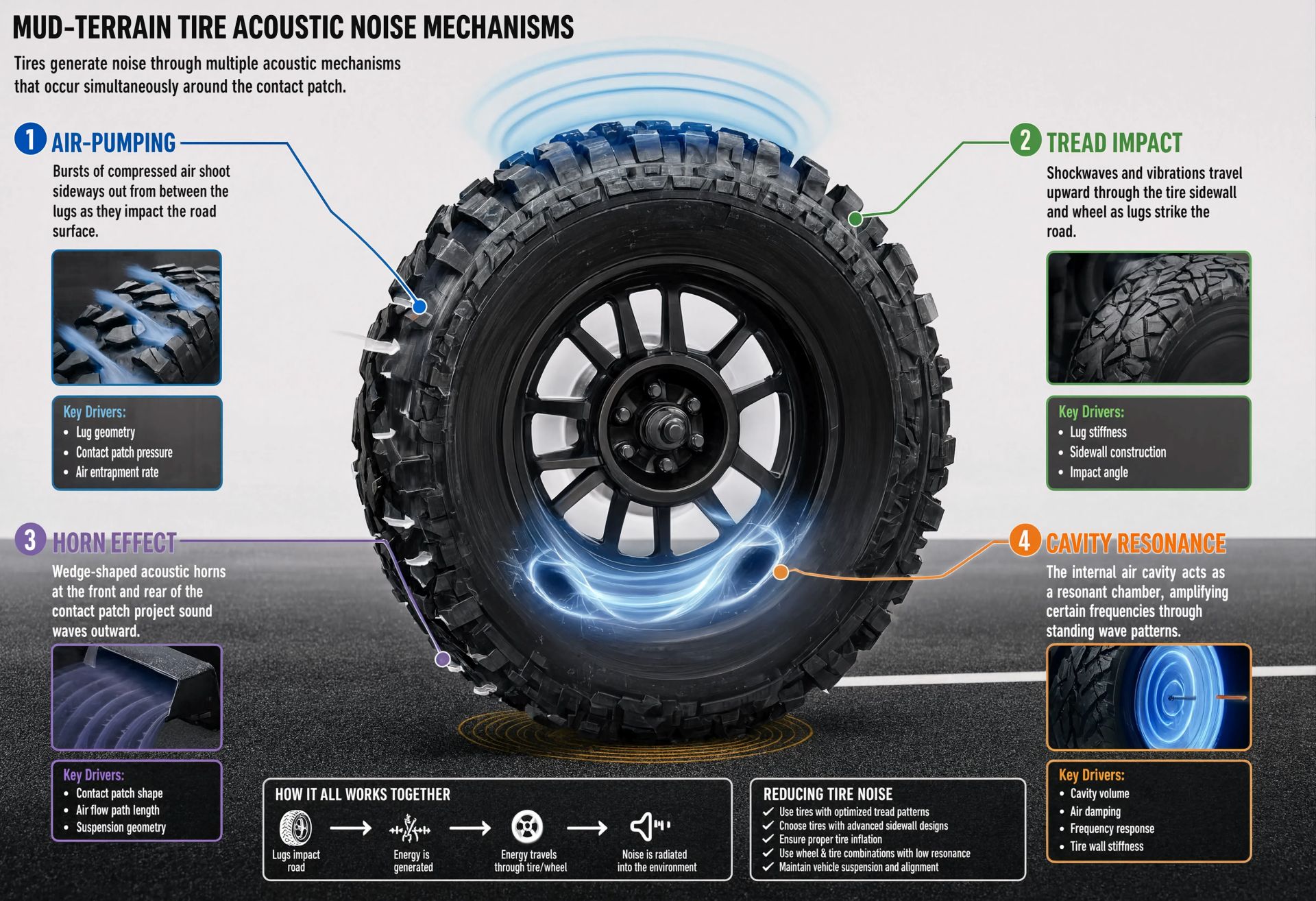
1. Air-Pumping. As the tire rotates, air gets trapped in the large void spaces between lugs. The moment each lug enters the contact patch, it compresses that air column and releases it explosively outward. The larger and more open the void pattern – exactly what makes an M/T effective in mud – the more violent this effect, as documented in Li's review of tire–pavement interaction noise (2018), Wang's comprehensive textbook on automotive tire acoustics (2020), and a 3D computational study by Gautam & Chandy (2016).
2. Tread Impact. Every lug that strikes pavement delivers a small but real mechanical impact. Multiply that by the number of lugs hitting per second at highway speed, and you get a continuous vibration transmitted through the tire carcass, through the wheel, through the suspension, and into the cabin. The foundational 1984 SAE paper by Ejsmont, Sandberg, and Taryma identified this tread impact as one of the primary structural noise mechanisms – a finding still cited in tire acoustic research 40 years later.
3. The Horn Effect. The geometry of the contact zone – where tire meets road – creates a wedge-shaped cavity that functions as an acoustic horn, amplifying and projecting sound outward. The wider the tread voids, the more pronounced this amplification. Gautam & Chandy's 2016 three-dimensional CFD study confirmed that void geometry is a primary driver of projected exterior noise.
4. Cavity Resonance. The sealed air column inside your tire – between the tread and the wheel – acts like a tuning fork. It resonates at a predictable frequency determined by tire size, inflation pressure, and running speed. The Applied Acoustics study by Hu et al. (2020) confirmed that pressure and velocity both shift this resonance peak. A companion measurement study by Tanaka et al. (2016) showed that OEM manufacturers have started lining the inner surface of premium tires with polyurethane foam specifically to dampen this effect.
From Mechanism to Sound: What This Means for Your Ears
These four mechanisms don't operate independently. They combine, overlap, and amplify each other – which is why M/T noise at highway speed isn't just "louder" than A/T noise. It has a different character: tonal, directional, and fatiguing in a way that flat broadband noise isn't.
Q: I've had M/T tires before and they weren't this loud. What changed?
A: Three likely culprits: (1) the new tires have a more aggressive void ratio, (2) your shocks are worn and no longer absorbing the tread impact vibrations before they reach the cabin, or (3) the tires haven't broken in – new M/T tires are typically louder for the first 500–1,000 miles as surface rubber wears to expose the full block geometry.
Q: Why does the noise change depending on which road I'm on?
A: Road surface texture has a measurable impact on tire noise independent of tire type. A pavement acoustics study by Liu et al. (2021) found that pavement macrotexture drives noise below 1,000 Hz, while surface stiffness influences the peak frequency zone between 700–1,300 Hz. Fresh smooth asphalt absorbs and dissipates sound differently than chip-seal or worn concrete, as confirmed in Pizzo et al.'s 2020 Applied Acoustics research on rubberized paveme.
Now that you understand how the noise is generated, let's look at where it lands – because not all noise is equally noticeable or equally fatiguing.
The Roar Zone: 700–1,300 Hz
This is the band where M/T tires announce themselves. Acousticians call what happens here the multi-coincidence peak – a term coined in Sandberg's widely cited 2003 EURONOISE paper on tyre/road noise spectra to describe a genuinely unusual acoustic phenomenon. At highway speeds, multiple independent physical factors resonate in the same frequency range simultaneously: tread pattern pitch repetition, pipe resonances in tread grooves, tangential block resonances, belt resonances, and the horn effect. This convergence produces a pronounced, tonal spike that dominates the acoustic profile – the drone you hear on the interstate.
The Vibration Zone: 10–50 Hz
Low-frequency tire noise is different in kind, not just degree. Below 50 Hz, the energy doesn't primarily reach you as sound – it reaches you as physical vibration transmitted through the seat, floor, and steering wheel. A Japanese measurement study by Ishihama et al. (2016) found strong correlations between tire cavity energy in this range and chassis vibration measured at the occupant position – the sustained sub-audible stimulus that makes long highway runs exhausting.
How M/T, R/T, and A/T Compare
Conceptual comparison based on industry benchmarks and published acoustic research – Yang et al. (2025); Guan et al. (2023); Ejsmont et al. (1984)
Parameter | M/T | R/T (Hybrid) | A/T |
|---|---|---|---|
Highway noise (65 mph) | Very High | Moderate–High | Moderate |
700–1,300 Hz peak | Pronounced | Reduced | Moderate |
Low-frequency vibration | High | Moderate | Low–Moderate |
Noise increase with speed | Steep | Gradual | Gradual |
Off-road capability | Maximum | High | Moderate |
Self-cleaning in mud | Excellent | Good | Limited |
Tread life (highway) | Shorter | Moderate | Longer |
Recommended for | <20% pavement | 50/50 use | >80% pavement |
Example models | BFG KM3, Toyo Open Country M/T | Nitto Ridge Grappler, Toyo AT3 | BFG KO2, Falken Wildpeak AT |
Q: My buddy says his M/T tires are totally fine on the highway. Am I doing something wrong?
A: Likely not – but context matters. Cabin noise perception depends heavily on the vehicle's sound deadening, roof height, cab type, and suspension setup. A full-size crew cab with aftermarket sound deadener can mask 5–8 dB of tire noise that a single-cab short-bed transmits directly. "Fine for him" isn't necessarily "fine for a 60-mile daily commute."
What Makes It Worse: Wear, Speed, Road, and Suspension
Tire noise isn't static. A set of M/T tires that were manageable at purchase can become genuinely obnoxious – not because anything broke, but because several compounding factors are left unmanaged.
Speed: The Primary Amplifier
Vehicle speed is the single most significant variable affecting tire/road noise – more than tire type, road surface, or load. A full-scale track study (2025) by Yang et al. in Applied Sciences confirmed this hierarchy across all tire and pavement combinations. The relationship isn't linear: air-pumping noise and horn effect intensity both accelerate disproportionately as speed increases. What sounds manageable at 45 mph can feel overwhelming at 75 mph – not because the tire changed, but because the physics compounded.
Why Wear Makes Everything Worse
New M/T tires wear unevenly faster than highway tires, and as they do, they develop a pattern called cupping or scalloping – irregular high and low spots around the circumference. Each of those spots becomes an impact event with every rotation, adding chaotic tonal components on top of the baseline drone. Worn, hardened rubber also loses natural damping properties, so more of the tread impact energy transmits to the carcass rather than being absorbed. Both Li's 2018 review in the journal Designs and Wang's 2020 textbook on automotive tire acoustics document this wear–noise progression as a fundamental characteristic of open-lug tire designs.
Q: My tires aren't that old, but the noise got noticeably worse over the last few months. What's going on?
A: Check four things in this order: (1) tire pressure – even 5 PSI low shifts resonance frequencies; (2) rotation schedule – M/T tires should be rotated every 3,000–5,000 miles; (3) alignment – a toe or camber issue accelerates edge wear dramatically; (4) shocks – see below.
Tires don't transmit noise directly to your ears – they transmit vibration into the wheel, which travels through the suspension into the chassis and body. A healthy shock absorber dampens that transfer. A worn one passes it through with minimal attenuation. INTER-NOISE and NOISE-CON Congress and Conference Proceedings documented exactly this vibration pathway – low-frequency energy in the 10–50 Hz range showing strong correlation with chassis acceleration at the occupant position.
The practical result: if you've installed new M/T tires and the highway feel is worse than expected, the tire is often not the primary culprit. Shock absorbers with 80,000+ miles on them are genuinely inadequate dampers for the additional unsprung weight and vibration input of large M/T tires. Upgrading shocks as part of a tire/wheel package is not upselling – it's acoustically justified.
Q: Will upgrading my shocks actually reduce tire noise in the cabin?
A: Yes, measurably. The mechanism is structural, not acoustic – better shocks interrupt the vibration pathway between tire and chassis. This won't change how loud the tire sounds outside the truck, but it will significantly reduce what reaches the driver. For 35"+ M/T builds, shock upgrade should be part of the fitment conversation, not an afterthought.
Road Surface: The Variable You Can't Control
The same tire sounds different depending on where you drive. Liu et al.'s 2021 pavement condition study measured tire/road noise across multiple pavement types and found that macrotexture primarily drives noise below 1,000 Hz, while surface stiffness influences the 700–1,300 Hz peak band directly. Pizzo et al.'s 2020 research on rubberized pavements in Applied Acoustics confirmed a linear relationship between road texture characteristics and tire noise spectrum. Chip-seal and exposed-aggregate surfaces amplify tire noise by 3–5 dB compared to dense-graded asphalt.
Practical Solutions: Keeping the Noise Under Control
Noise management for M/T tires is a maintenance discipline, not a one-time fix. Consistent execution of three practices covers the majority of preventable noise increase.
The Cross-Rotation Protocol
Rotate in a Rearward Cross pattern every 3,000–5,000 miles – significantly more frequently than the 6,000–8,000 miles recommended for passenger tires. M/T tires on driven axles develop wear differentials faster due to torque loading and the larger individual contact events from aggressive lugs. Skipping rotations allows the early stages of cupping to become permanent.
The Chalk Test for Precision PSI
The method: Apply chalk across the full tread width. Drive straight on dry pavement for 50 feet. Inspect: uniform chalk erasure across the full width indicates the correct contact patch. Heavy wear in the center means over-inflation; edge wear means under-inflation.
Why this matters acoustically: beyond the blowout risk documented in the NHTSA's tire safety guide, Hu et al.'s 2020 Applied Acoustics study confirmed that inflation pressure is a direct variable in cavity resonance frequency. An incorrectly inflated tire resonates at a pitch it wasn't designed for – you're not just accelerating wear, you're shifting the drone to a less manageable range.
Road Force Balancing
Standard spin balancing measures static weight distribution. It does not detect radial force variation – the variation in how hard the tire pushes against the road as it rotates due to non-uniform stiffness in the carcass. On tires 33" and larger, this variation creates a low-frequency harmonic input that standard balancing completely misses. Road Force technology applies a load roller simulating actual driving forces, measuring radial force variation directly – dynamic loading methodology validated in a 2022 SAE paper by Lee et al. For M/T tires in the 35"+ range, this is the appropriate standard – not an upgrade.
Q: I just had my tires balanced and I still feel a vibration at 65 mph. Could it still be a balance issue?
A: Yes – if it was balanced on a standard spin balancer. Road Force balancing would identify radial force variation that standard balancing can't detect. Also confirm that the balance was performed with the tire mounted to your specific wheels, as offset and backspacing affect the mass distribution measurement.
The Hybrid Alternative: When to Choose R/T over M/T
If you commute 40+ miles a day and use your truck off-road occasionally – which describes the majority of Level 4x4 customers – the Rugged-Terrain (R/T) hybrid category was designed specifically for you.
R/T tires reduce noise through two primary mechanisms. First, tighter center block spacing lowers the void ratio in the contact patch center, directly reducing air-pumping amplitude at highway speeds. Second, variable pitch – the deliberate randomization of lug spacing around the circumference – prevents any single frequency from dominating the acoustic output, as demonstrated in 2023 Journal of the Acoustical Society of America study by Guan et al. and a 2012 pitch-sequence optimization study by Kim et al. When lug spacing is uniform, every rotation produces a tonal peak at the frequency corresponding to that interval. Variable pitch distributes energy across a broader frequency range, trading a pronounced tonal peak for a lower-amplitude broadband noise – a mechanism Wang details in his textbook on automotive tire noise (2020).
The R/T Comparison
M/T | R/T (Hybrid) | |
|---|---|---|
Highway noise characte | Tonal drone | Broadband hum |
700–1,300 Hz peak | Pronounced | Significantly reduced |
Aggressive sidewall look | Full | Full |
Void ratio (center) | High | Medium |
Mud self-cleaning | Excellent | Good |
Rock crawling grip | Maximum | High |
Ideal pavement % | Under 20% | Up to 60–70% |
Representative models | BFG KM3, Toyo Open Country M/T | Nitto Ridge Grappler, Toyo AT3, Mickey Thompson Baja Boss A/T |
Q: Will an R/T tire look as aggressive as an M/T?
A: The sidewall – which defines visual stance from a distance – is essentially identical on premium R/T hybrids like the Ridge Grappler. The difference is in the center tread pattern, which is visible only up close. From the curb, from a job site, from another truck at a light: R/T reads as M/T. The compromise is in extreme mud self-cleaning performance, not aesthetics.
Q: I've seen some R/T tires that are just as loud as M/T. Is the category reliable?
A: There's significant variance within the R/T category. Look for models that explicitly call out variable pitch or acoustic optimization in their technical specs. The Nitto Ridge Grappler and Toyo Open Country AT3 are examples of tires whose noise engineering aligns with the pattern design principles documented in Guan et al.'s 2023 JASA study on tread pattern noise reduction.
Why Level 4x4 Is Your Best Defense Against Tire Noise
Wheel and tire fitment is an engineering decision, not a transaction. The most common post-purchase noise complaint we see isn't caused by a bad tire – it's caused by a tire that wasn't matched correctly to the wheel, the suspension, or the intended use.
Verified Fitment. We check offset, backspacing, and clearance before your order ships. Rubbing – tire-to-fender, tire-to-control-arm, tire-to-brake-caliper contact – produces a cyclical scraping noise that no amount of balancing or rotation addresses, because it's a geometry problem. It also destroys tires.
Installation-Ready Packages. Every package ships professionally mounted, Road Force balanced, and inspected for radial force variation. We don't batch-balance and ship.
The Suspension Conversation. If you're stepping up to 35s or larger, we'll ask about your shocks. Installing large-format M/T tires on worn factory dampers adds vibration input into a system that can no longer attenuate it. The result is cabin noise that gets blamed on the tires when the intervention point was always the suspension.
Building a system right the first time saves you money in the long run – and with our flexible financing options, your perfect setup is closer than you think.
Summary: Professional Setup Beats DIY Luck
Modern off-road builds are complex systems where tread pattern, inflation pressure, wheel offset, suspension geometry, and road surface all interact to produce the acoustic experience you live with every day. Forum hacks target one variable at a time and ignore the system. At Level 4x4, every build is engineered as a system – not assembled from parts.
The aggressive stance Jason is building for should command respect on the job site and stay quiet enough on the interstate to take a call. That's achievable – with the right tire category, correct fitment, and a maintenance discipline that treats the build as an ongoing responsibility, not a one-time purchase.
References
1. McBride, S., Motaharibidgoli, S., Albakri, M., Burdisso, R., Tarazaga, P., & Sandu, C. (2019). Experimental Study on Tire Vibrations and Induced Noise.. Topics in Modal Analysis & Testing, Vol. 8. doi:10.1007/978-3-030-12684-1_34
2. NHTSA (2006). The Pneumatic Tire.. U.S. Department of Transportation. nhtsa.gov/pneumatictire.pdf
3. Li, T. (2018). Influencing parameters on tire–pavement interaction noise: Review, experiments, and design considerations.. Designs, 2(4). mdpi.com – Designs 2(4)
4. Li, T. (2019). A review on physical mechanisms of tire-pavement interaction noise.. SAE International Journal of Vehicle Dynamics. https://www.researchgate.net/publication/333459770
5. Wang, X. (2020). Automotive Tire Noise and Vibrations: Analysis, Measurement and Simulation.. Butterworth-Heinemann. Google Books
6. Ejsmont, J. A., Sandberg, U., & Taryma, S. (1984). Influence of tread pattern on tire/road noise.. SAE Transactions. jstor.org/stable/44721504
7. Gautam, P., & Chandy, A. J. (2016). A three-dimensional numerical investigation of air pumping noise generation in tires.. Journal of Vibration and Acoustics, 138(6). doi:10.1115/1.4033891
8. Sandberg, U. (2003). The multi-coincidence peak around 1000 Hz in tyre/road noise spectra.. Proceedings of EURONOISE. [78 citations] consensus.app
9. Hu, X., Liu, X., Wan, X., Shan, Y., & Yi, J. (2020). Experimental analysis of sound field in the tire cavity arising from the acoustic cavity resonance.. Applied Acoustics. doi:10.1016/j.apacoust.2019.107172
10. Tanaka, Y., Horikawa, S., & Murata, S. (2016). An evaluation method for measuring SPL and mode shape of tire cavity resonance.. Applied Acoustics. doi:10.1016/j.apacoust.2015.12.009
11. Ishihama, M., Matsumoto, K., Miyoshi, K., Yoshii, K., & Kanda, M. (2016). Tire Cavity Sound Measurement for Identifying Characters of Road Surfaces and Tire Structures.. SAE Technical Paper. consensus.app
12. Guan, L., Gao, M., Ma, Z., & Yu, C. (2023). Research on the effect of tire pattern design on noise and its reduction.. Journal of the Acoustical Society of America, 154(4). doi:10.1121/10.0022185
13. Kim, E. Y., Hwang, S. W., & Lee, S. K. (2012). Image-based approach to optimize the tyre pitch sequence for a reduction in the air-pumping noise.. Proc. IMechE Part D. doi:10.1177/0954407012439950
14. Lee, K. et al. (2022). Fatigue Analysis for Automotive Wheel Bearings.. SAE Technical Paper 2022-01-1193. sae.org – 2022-01-1193
15. Landsberger, B. J., & DeMoss, J. (2001). Effects of air and road surface temperature on tire pavement noise.. SAE Paper 2001-01-1598. sae.org – 2001-01-1598
16. Yang, G., Wang, X., Chen, L., & Dong, Z. (2025). Study on influencing factors and spectrum characteristics of tire/road noise of RIOHTrack full-scale test road.. Applied Sciences. doi:10.3390/app15179741
17. Liu, H., Zhang, Y., Xu, Z., & Hou, X. (2021). Influence of material properties on tire/road noise for non-destructive pavement condition assessment. Journal of Physics: Conference Series. doi:10.1088/1742-6596/1965/1/012105
18. Pizzo, A., Teti, L., Moro, A., Bianco, F., Fredianelli, L., & Licitra, G. (2020). Influence of texture on tyre road noise spectra in rubberized pavements.. Applied Acoustics. doi:10.1016/j.apacoust.2019.107080
19. Leupolz, M., & Gauterin, F. (2022). Vehicle impact on tire road noise and validation of an algorithm to virtually change tires.. Applied Sciences. doi:10.3390/app12178810
20. Wei, Y., Feng, Q., Wang, H. et al. (2016). A hybrid numerical-experimental analysis for tire air-pumping noise with application to pattern optimization.. Noise Control Engineering Journal. researchgate.net/publication/298330467
21. Guo, T.-W., & Cheng, J.-H. (2021). Modelling of air pumping noise and study of tread pattern pitch.. Journal of Applied Science and Engineering. jase.tku.edu.tw